
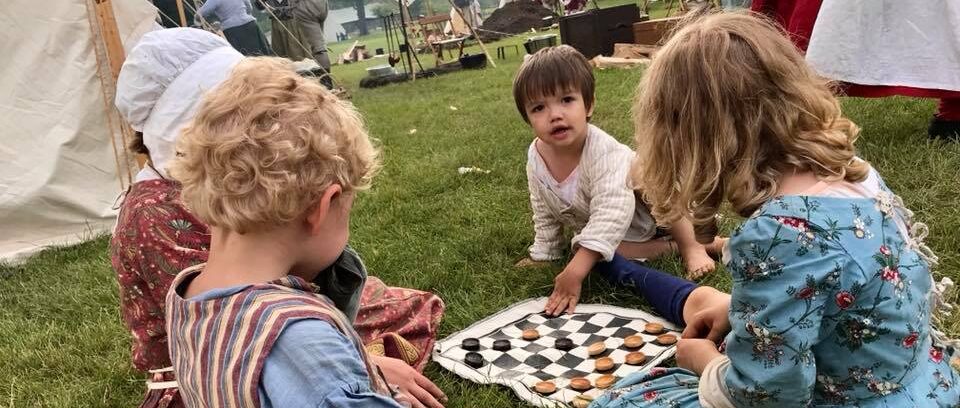
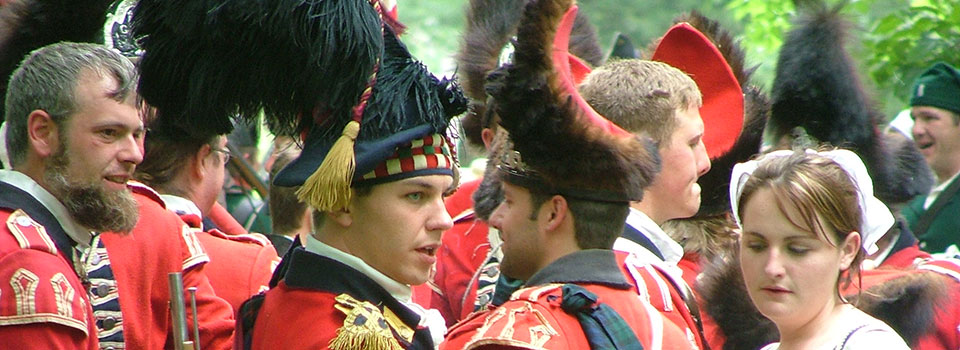
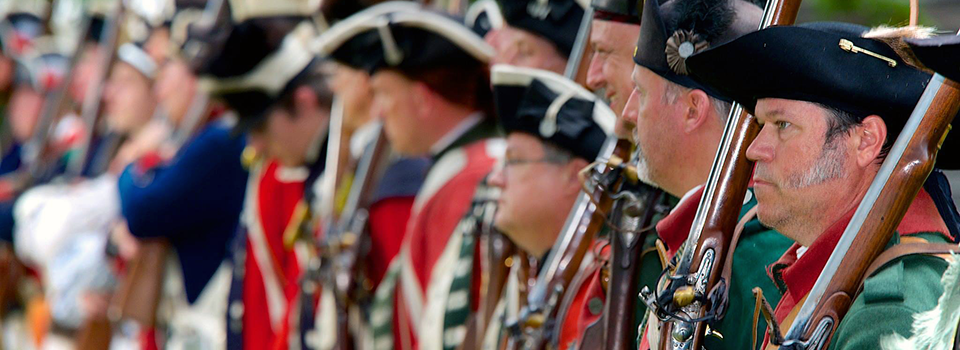
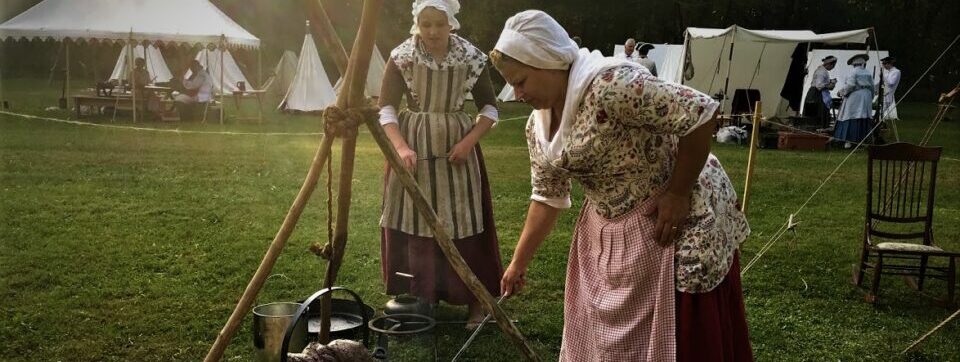
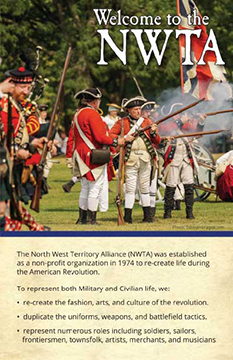
The North West Territory Alliance (NWTA) is an American Revolutionary War reenactment organization located in the Midwestern United States. We have over five hundred members from states as far west as Iowa, east to Ohio, North to the Canadian border, and south to Tennessee.

We are a non-profit educational organization that studies and recreates the culture, lifestyle, and arts of the time of the American Revolution, 1775-1783. We strive to duplicate the uniforms, weapons, battlefield tactics, and camp life of the era as accurately as possible.

Comments Box SVG iconsUsed for the like, share, comment, and reaction icons

Aprons, a useful garment designed to protect a woman’s clothing were almost always worn across classes. Even upper class women, although often not working, wore aprons made of finer fabrics to complete their look. Laborers and working women wore aprons most commonly made of blue and white checked linen. In “Had on and Took With Her” edited by Sue Huesken and Karen Mullian, checked aprons are often described as worn by runaway servants in Pennsylvania: “She had on, and took with her, a black bonnet, furniture check petticoat, striped short gown, check apron…” August 17, 1775, Pennsylvania Evening Post. You’ll see reenactors frequently wearing these checked aprons at camp.
Thanks to Stephen Gilbert and Paul Dickfoss @Wm. Booth, Draper for research and period images.
... See MoreSee Less

Comment on Facebook

Also their fantastic for men. When ever i do something messy throw mine on.

Paul Dickfoss of Wm Booth Draper has had two of the checked fabrics made. One of them he shared and it is now sold by several vendors. These blue checks are so beautiful. I love the page of checks our poster showed.

April 12, 1782 Battle at Les Saintes: British fleet under Admiral George Rodney defeats the French fleet under Comte de Grasse off Dominica in the West Indies. Prevents a planned French and Spanish invasion of Jamaica.

With a long-standing historical rivalry against the British it was only natural that the French would join the side of the Americans during the American Revolutionary War. (They would, of course, experience their own egalitarian revolutionary upheavals only a few years later.)

To aid the cause the French had planned to invade the highly profitable British colony of Jamaica, which was itself more profitable than the Thirteen Colonies in revolt. The French Navy also planned to defeat the British squadron at New York and capture the Windward Islands.

These plans were destroyed by the British destruction of the French fleet at the Battle of the Saintes, near the West Indies. During the battle the British navy 'broke through' the French line, throwing them into chaos and causing a rout.

French commander Comte De Grasse was captured by Admiral George Rodney but was released to France in 1784, where he demanded a court-martial that acquitted him of responsibility for France's loss.

In total the British lost nearly 300 men and France somewhere around 2-3,000.
... See MoreSee Less

April 12, 1782 Battle at Les Saintes: British fleet under Admiral George Rodney defeats the French fleet under Comte de Grasse off Dominica in the West Indies. Prevents a planned French and Spanish invasion of Jamaica. With a long-standing historical rivalry against the British it was only natural that the French would join the side of the Americans during the American Revolutionary War. (They would, of course, experience their own egalitarian revolutionary upheavals only a few years later.) To aid the cause the French had planned to invade the highly profitable British colony of Jamaica, which was itself more profitable than the Thirteen Colonies in revolt. The French Navy also planned to defeat the British squadron at New York and capture the Windward Islands. These plans were destroyed by the British destruction of the French fleet at the Battle of the Saintes, near the West Indies. During the battle the British navy broke through the French line, throwing them into chaos and causing a rout. French commander Comte De Grasse was captured by Admiral George Rodney but was released to France in 1784, where he demanded a court-martial that acquitted him of responsibility for Frances loss. In total the British lost nearly 300 men and France somewhere around 2-3,000.

April 9, 1784. Great Britain ratified the Treaty of Paris, which officially ended the American Revolutionary War.
While the definitive treaty was signed on September 3, 1783, in Paris by representatives of King George III and the United States, the ratification process took several months.
The Continental Congress ratified the treaty on January 14, 1784, in Annapolis, Maryland, a date often celebrated as "Ratification Day".
King George III ratified the treaty on April 9, 1784.
The final, ratified documents were exchanged in Paris on May 12, 1784, officially finalizing the peace.
The treaty formally recognized the United States as a free, sovereign, and independent nation, ending eight years of war.
Terms: The treaty established the new nation's borders, extending from the Atlantic Ocean to the Mississippi River, and from Canada to Spanish Florida.
... See MoreSee Less

April 9, 1784. Great Britain ratified the Treaty of Paris, which officially ended the American Revolutionary War. While the definitive treaty was signed on September 3, 1783, in Paris by representatives of King George III and the United States, the ratification process took several months. The Continental Congress ratified the treaty on January 14, 1784, in Annapolis, Maryland, a date often celebrated as Ratification Day. King George III ratified the treaty on April 9, 1784. The final, ratified documents were exchanged in Paris on May 12, 1784, officially finalizing the peace. The treaty formally recognized the United States as a free, sovereign, and independent nation, ending eight years of war. Terms: The treaty established the new nations borders, extending from the Atlantic Ocean to the Mississippi River, and from Canada to Spanish Florida.

Comment on Facebook

Finally, the end of the “Revolutionary War,” 242 years ago today! Who would have thought that it would take almost 8 years after thinking the Declaration was declaring independence for it to finally become a reality? Then, after the Constitution was adopted and ratified in 1788, the creation of the federal government still had to happen for the official "birth" of the government, with all three branches functioning. And, that would still take more than 6 more years, until February 1, 1790. So, the official "Birth" of the United States Government was about 13-1/2 years after the Declaration, which it turned out, was actually the "Conception"… a very long gestation period, indeed!

On April 7, 1776, exactly 250 years ago today, the brig USS Lexington captured the British sloop H.M.S. Edward during the American Revolution. Remarkably, the audacious action took place just off the coast of Virginia, right in front of the eyes of the powerful British naval blockade force.
Lexington was commanded by Captain John Barry, Continental Navy. The Edward was brought to Philadelphia as a prize.
... See MoreSee Less

On April 7, 1776, exactly 250 years ago today, the brig USS Lexington captured the British sloop H.M.S. Edward during the American Revolution. Remarkably, the audacious action took place just off the coast of Virginia, right in front of the eyes of the powerful British naval blockade force. Lexington was commanded by Captain John Barry, Continental Navy. The Edward was brought to Philadelphia as a prize.

Lucy Worsley Investigates: The American Revolution starts Tuesday April 7 on PBS. Check your local listings.

www.facebook.com/share/r/1G9thQFsAU/?mibextid=wwXIfr
... See MoreSee Less

Load more

Upcoming Events